
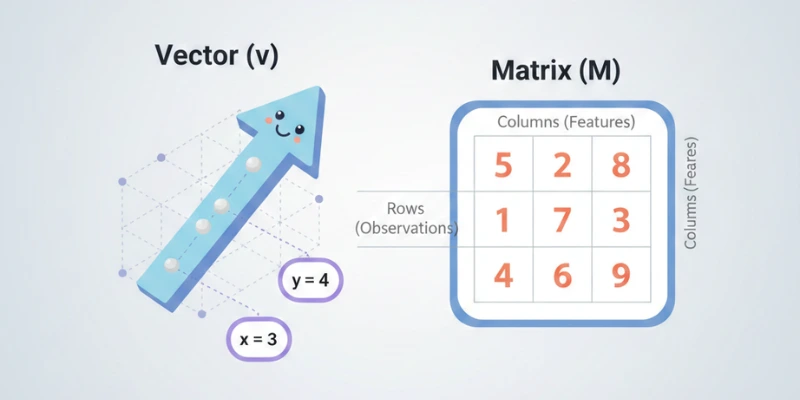
Vectors and matrices are core ideas in linear algebra and form the backbone of data science and machine learning. Many beginners find these concepts confusing because they are often taught with heavy math symbols. Enrolling in a Data Science Course in Trivandrum at FITA Academy can help learners build an intuitive understanding, making these concepts easier to grasp and more useful in practice. When you see vectors and matrices as simple ways to organize and move information, they start to make sense.
What Is a Vector in Simple Terms
A vector can be thought of as an ordered list of numbers. Each number represents a value that belongs together with the others. In data science, a vector often describes one data point. For example, a student can be represented by age, marks, and attendance. Each of these values becomes one position in the vector.
Vectors also have direction and size when viewed geometrically. This idea helps explain why vectors are useful for representing movement, change, or position. In data analysis, this translates to how features vary together. Thinking of a vector as a single row or column of meaningful values improves clarity.
Why Vectors Matter in Data Science
Vectors allow complex information to be handled in a structured way. Machine learning models do not understand words or images directly; they work with numbers arranged as vectors. Every row in a dataset is usually a vector describing one observation. Joining a Data Science Course in Kochi can help learners understand how vectors and other core concepts are applied in real-world data science projects.
Operations on vectors help compare data points. Measuring similarity between vectors helps in recommendation systems and clustering. Because of this, vectors are a fundamental building block in data science workflows.
Understanding Matrices Without Fear
A matrix is simply a collection of vectors arranged in rows and columns. If a vector represents one data point, then a matrix represents many data points together. A dataset stored in a table format is a perfect example of a matrix.
Each row usually represents one observation, and each column represents one feature. This structure allows efficient storage and processing of large amounts of data. Matrices make it possible to apply the same operation to many vectors at once.
How Matrices Help Process Data
Matrices make data transformations easier and faster. Scaling features, combining variables, or applying linear models all rely on matrix operations. These operations may look complex in math form, but conceptually they are organized calculations done on grouped data. A Data Science Course in Delhi offers practical instruction to excel in matrices and their uses.
In machine learning, model parameters are often stored as vectors or matrices. Predictions are generated by combining input matrices with parameter matrices. Understanding this flow helps explain how models learn patterns from data.
Visualizing Vectors and Matrices Mentally
A helpful way to visualize a vector is to imagine a point in space defined by coordinates. Each coordinate corresponds to one value in the vector. A matrix can be imagined as a grid of such points or values arranged neatly.
This mental picture reduces abstraction and builds confidence. Instead of seeing symbols, you start seeing structure and meaning. This approach is especially helpful when learning data science basics.
Why Intuition Comes Before Math
Memorizing formulas without intuition leads to confusion. When you understand what vectors and matrices represent, the math becomes easier to follow. Understanding vectors and matrices becomes easier through a Data Science Course in Jaipur focused on practical learning.
For anyone learning data science, building this understanding early is essential. Vectors and matrices are not just math topics. They are practical tools for working with real world data.
Also check: The Role of Storytelling in Data Visualization